New · Sites: publish on your own domain
The AI operating system that runs your business on autopilot.
Describe what you need. Knolo builds the assistants, agents, knowledge and website behind it, all connected, all no-code, and keeps them running while you get on with your day.
The Keep-What-You-Build Start: 20,000 credits free, no card. Everything you build stays yours.
knolo.io/spaces/cafe-lindner
Café Lindner
Command center · continue work, spin up agents, open minds
1 assistant
4 agents
6 minds
1,463 documents
Good morning. What should Lindner Assistant take care of?
Continue
2 live runsRecent conversations
Agent runs
Agents
Minds
knolo.io
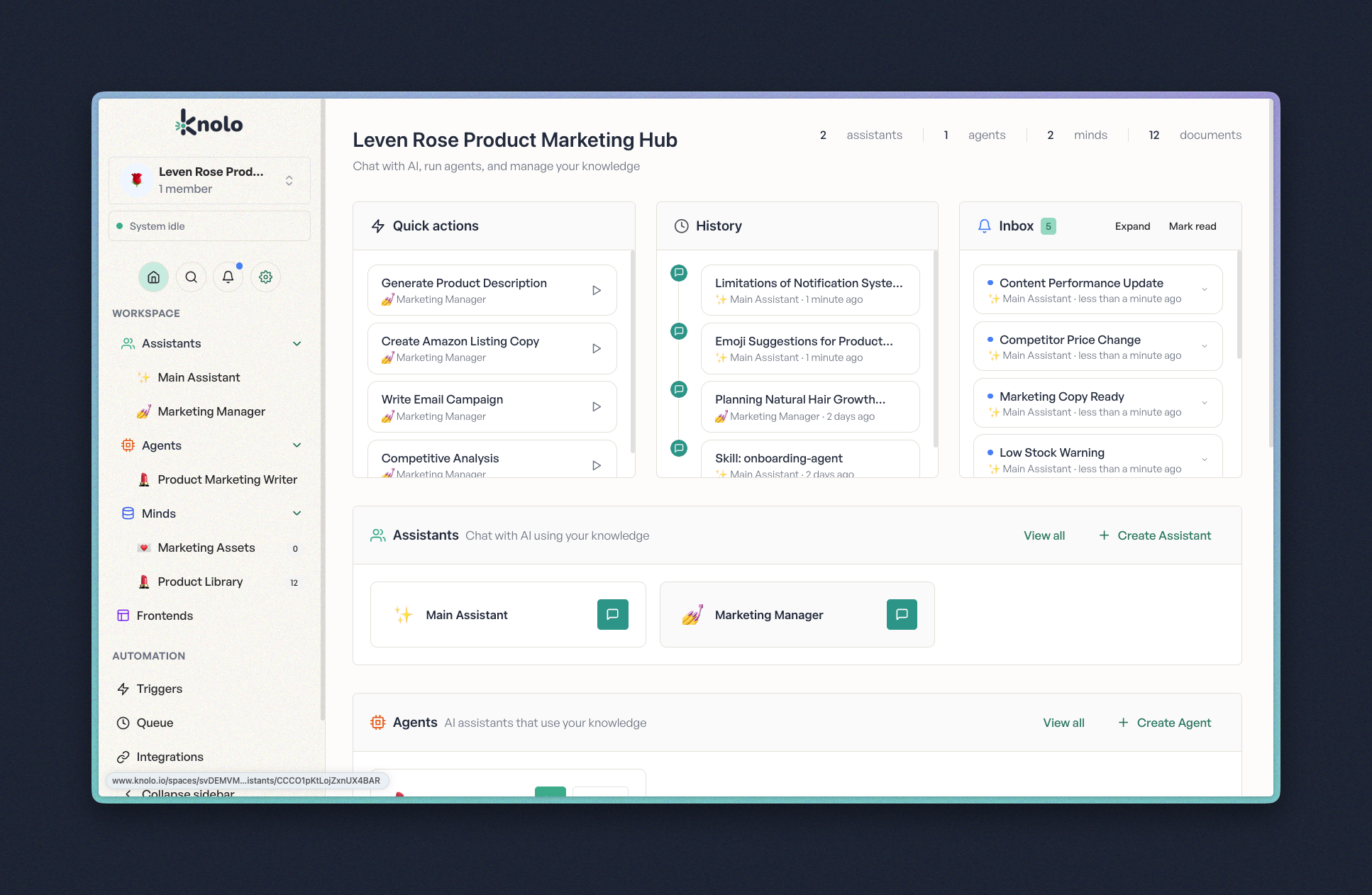
Café Lindner is a demo workspace. Click around, everything works. Start building yours →
Built and running on Knolo
How Anyway, Vienna runs itself
anywayvienna.comFacebook Lead Ads
Signups from ads
Local advertisers
Cold emails via Gmail
Knolo Space
Minds
Research Queue
Drafts
Subscribers
Growth Stats
Agents
Research
Writer
Review
Sender
Kit
Sends every issue
Google Analytics
Opens, clicks, visits
Monetization
Pays for the growth above
Agents
Outreach
Minds
Sponsor CRM
01 / 08
A reader signs up through a Facebook ad. The lead lands in Subscribers.
“I run a local newsletter and website with 20,000 subscribers, and 90% of it is managed by Knolo while I'm asleep.”

AI
Claire
Editor, Anyway, Vienna
An AI avatar, run by an AI. The other 10% is the human who reviews each issue.
Newsletter Monetization Engine Skill
Sites Skill
Integrations
Your agents log in, so you don't have to.
Connect an app once for the whole Space. Then hand each agent only the tools its job needs: the booking agent gets your inbox and calendar, not your Stripe account.
Concierge
3 TOOLS GRANTED · 8 MORE IN THIS SPACE
3,000+ apps, plus any MCP server you bring. Keys never reach the model.
The missing piece
Most AI tools stop at the chat window. Your customers never see it.
ChatGPT writes it. Zapier moves it. A website builder shows it. None of them know about each other, so you end up as the glue. Knolo puts all three in one system you build by talking to it.
Site
🌐
The front door
A real website on your domain. Pages read straight from your Minds, and forms write straight into them.
Minds
🗂️
The memory
Your content, customers and leads in one place. Edit a row and the live site updates, with no redeploy.
Agents
⚙️
The staff
They pick up every signup, lead and request as it lands, then qualify it, reply to it, write about it or publish it.
- A visitor fills in a form
- A row lands in a Mind
- An agent follows up
- New content goes liveand around again
What it builds
Say what you want. Get a business that runs, in public.
One sentence becomes the whole thing: the website, the Minds behind it and the agents that keep it moving. Three examples:
What it does
It builds. It runs on time. It keeps the site live.
Follow-ups get sent, Minds stay current, the site stays fresh. You don't have to remember any of it.
KNOLO · ASSISTANT
BUILDING
✓ MINDS · RESEARCH QUEUE, DRAFTS, SUBSCRIBERS
✓ AGENTS · SCOUT, WRITER, SENDER
● SITE · WAITING FOR YOUR PICK
Start from a Skill
Proven blueprints. Many ship with a site.
A Skill sets up a whole system from one sentence, then you make it your own. The ones marked with a globe can also put their output online: a newsletter gets its signup site, an outreach engine gets its landing page.
Behind the site
The whole system, not just the page.
A site is only as good as what answers when someone uses it. In Knolo the site sits on a real operating system for your business, and you build every part of it by talking to it.
knolo.io
Assistants
Chat that knows your business. It searches your Minds, calls your tools and builds the rest of the system with you.
Agents
Background workers with one job each. They run on a schedule or react to new rows, and save their results to Minds.
Minds
Documents, tables and files that remember. They are the CMS for your site and the shared memory for every agent.
Use it from anywhere
Reach your Space from Claude, ChatGPT or Cursor through the Knolo Connector, or from Chrome with the browser extension.
Yours to keep
Import your ChatGPT or Claude memory on day one. Everything you build, including the site's code, stays yours.
Why not just use…
Three tools and you as the glue, or one system.
Website builders · Framer, Wix, Lovable
A site with no brain.
It looks great, but every form goes to an inbox you work through by hand. Nothing behind it knows your business.
AI chat · ChatGPT, Claude, Gemini
A brain with no front door.
Smart in the moment, but it forgets your business between chats, and whatever it writes you still have to copy somewhere.
Automation tools · Zapier, Make, n8n
Plumbing you maintain.
You design every node and every IF block, then fix it when a step breaks. You end up thinking like an engineer.
Knolo
The site, the memory and the staff in one system, built from a conversation. No code, no nodes, no local setup, no engineer.
Under your control
They work with your keys, inside your rules, on the record.
You decide what they can reach and what needs your yes. Every step is logged.
KNOLO · SECRETS
3 STORED
NEVER SHOWN TO THE MODEL
Secret vault
Your keys live in the vault, never in the chat
Add an API key or password once. Agents read it at run time for the step that needs it. It never shows up in a thread and never reaches the model.
KNOLO · DRAFTS MIND
1 WAITING
SENDER RUNS ON STATUS = APPROVED
Review before send
Anything that goes out waits for your yes
Agents draft into a Mind. The sending agent only runs when you set the status to Approved, so nothing reaches a customer by accident.
KNOLO · RUN · SCOUT
TODAY
EVERY STEP, EVERY TOOL CALL, LOGGED
Run log
Every run is on the record
Each run keeps its steps: what the agent read, which tools it called, what it wrote and when. You never have to take its word for it.
Pricing
Build for free. Pay for the sites you put live.
The Keep-What-You-Build Start: every account begins with 20,000 credits and no card, enough to build and run your first system. Building never needs a subscription. The only recurring price is a Site Plan, and only for sites you publish.
Credits · for building and running
One-time packs. Never expire.
Starter
€29
≈ $31
29,000 credits
Plus
€79
≈ $85
85,000 credits
Popular
Pro
€199
≈ $215
230,000 credits
Scale
€499
≈ $539
580,000 credits
20,000 credits free to start, no credit card
Top up only when you need more, with nothing to cancel
Credits pay for chat, agents and building your site
Site Plan · per live site
€20
/ month
or €200 / year, two months free. No usage fees.
Hosting on fast global infrastructure
Your own domain, with the DNS records spelled out
Publish and roll back as often as you like
Content updates from your Minds without a redeploy
Cancel anytime. The site goes offline but is never deleted; renew and it comes back without a rebuild.
Prices are in euros. The dollar figure is an approximate conversion; you are charged in your local currency at checkout.
FAQ
Questions, answered.
What is Knolo?
Knolo is a no-code AI operating system for your business, with website publishing built in. You describe what you need in plain language, and it builds assistants, background agents, knowledge bases (Minds) and automations that run on your own data. It also publishes a real website on your own domain whose content and forms connect to that system. No code, no workflow nodes and no engineer required.
Can Knolo build and host my website?
Yes. Describe the site you want and Knolo designs it, builds it as a real Next.js website, shows you a live preview and publishes it when you say so, on your own domain if you like. Pages read their content from your Minds, and forms save every submission as a row that your agents can act on.
Can I use my own domain?
Yes. Once a site is published, add your domain and Knolo gives you the exact DNS records to create at your registrar: an A record for a root domain, or a CNAME for a subdomain. The site goes live on your domain as soon as DNS has propagated, usually within minutes to a few hours.
How much does a website cost?
Building and editing a site uses credits, like everything else in Knolo. Putting it live needs a Site Plan: €20 per month or €200 per year per site, with hosting, custom domains, publishing and rollback included, and no usage fees. If you cancel, the site goes offline but is never deleted, and renewing brings it back without a rebuild.
Is the website a template, or real code?
Real code. Every site is its own Next.js project, built from your brief and an art direction you choose, not a drag-and-drop template. The builder checks its work with desktop and mobile screenshots, every change is saved in the site's history, and you can undo any change or roll the live site back to an earlier version.
Do I need to know how to code to use Knolo?
No. There is no code, no workflow nodes and no local setup. You describe what you want and the assistant configures the assistants, agents, knowledge bases, triggers and website for you. You ask for changes the same way. Everything runs in the cloud and is always on.
What can I build with Knolo?
Complete systems with a public face: a newsletter with its signup website, research agent and review-gated sending; a lead-magnet landing page whose downloads are scored and followed up automatically; a local business site whose quote requests get triaged and answered. Behind the scenes you can also run content production, client delivery and research systems. Most start from a Skill and are built in one conversation.
How is Knolo different from ChatGPT, Zapier or a website builder?
Each of those covers one part. ChatGPT forgets your business between conversations and has no front door. Zapier, Make and n8n make you wire every step like an engineer. Website builders give you a page with nothing behind it. Knolo is one system: a website on your domain, Minds that remember, and agents that act on what comes in. You build all of it by describing what you want.
What are Minds, Assistants, Agents and Sites?
Minds are knowledge bases that store your documents, tables, files and AI-produced work; they are also the CMS for your website. Assistants are interactive chat that searches your Minds and calls tools. Agents run autonomously in the background, on a schedule or when new data arrives, and save their results. Sites are public websites on your domain that read from Minds and write form submissions into them. A Space is the workspace that holds all of them.
Who is Knolo for?
Knolo is built for people who run things rather than code things: solopreneurs and creators who want a working business system and a website without hiring, agencies and small teams who need a system per client, and local businesses who want inquiries answered fast. If you would rather describe the outcome than wire up tools, it is for you.
Is Knolo free to start?
Yes. Every account starts with 20,000 free credits and no credit card, enough to build and run your first system and build your first site. Credits come in one-time packs that never expire, with no subscription. The only recurring charge is a Site Plan, and only for sites you publish. Anything you build is yours to keep.
Your business, running. And online.
Describe it in a sentence. Knolo builds the system and the site, and you decide when it goes live. 20,000 credits free, no card, and everything you build stays yours.
Build my system — free